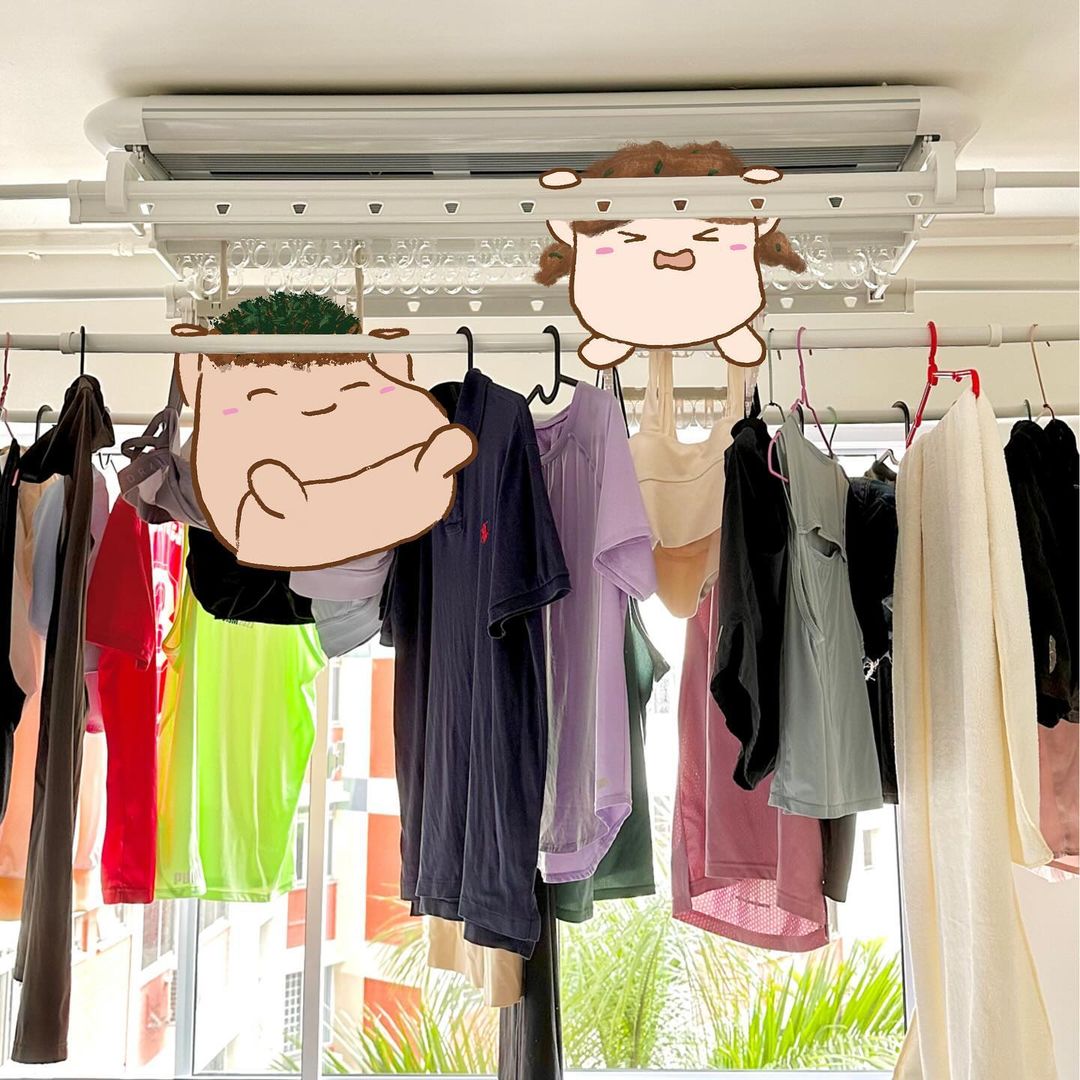
When we were renovating our 4-room resale HDB, we decided to splurge on a Steigen Solar Pro automated laundry drying system. At S$1,229.10 (this was in 2023!), it certainly wasn’t one of our cheapest renovation purchases, but we figured it would make doing laundry considerably more convenient.
There were a couple of reasons we were drawn to it. First, our flat doesn’t get much wind, which makes drying clothes naturally rather challenging. Second, one side of our unit faces the main road, so we weren’t particularly keen on hanging freshly washed clothes outside for hours, exposed to traffic-related dust and pollution.
We also liked the idea of having a ceiling-mounted laundry rack that could be raised and lowered automatically. Compared with traditional HDB laundry poles or a freestanding drying rack, it seemed like a much neater solution.
The Steigen Solar Pro appeared to tick all our boxes. It came with motorised lifting, fans, heated drying and additional features designed to help clothes dry faster, even without much natural airflow.
Unfortunately, having used it extensively in our home for almost 2 years, we have rather mixed feelings about it.
While we genuinely appreciate the convenience of the automated lifting system, we haven’t found the heated drying function nearly as effective as we’d hoped. Our clothes don’t always dry particularly well, and considering how much electricity the heating function consumes, it’s a little disappointing.
Here’s our experience with the Steigen Solar Pro, what we like about it, what we wish worked better, and whether we’d spend another S$1,229.10 on one today.
About this Steigen Solar Pro review
This review is based on our experience owning and using the Steigen Solar Pro automated laundry drying system in our 4-room resale HDB flat in Singapore.
We bought it because our flat doesn’t receive much natural wind, and we wanted a convenient way to dry laundry indoors without having to rely entirely on the weather.
We’ll cover how the Steigen Solar Pro works, how effective we’ve found the heated drying function, its electricity consumption, the benefits of its automated lifting mechanism, and whether we think it’s worth the premium price.
Our comments on drying performance reflect our experience at home rather than controlled testing. The technical specifications and electricity calculations are based on Steigen’s published product information, and features can differ between model generations.
Who is this guide for?
If you’re renovating an HDB or condominium in Singapore and considering an automated laundry drying rack, this review should help you decide whether the Steigen Solar Pro is worth paying for.
It will be particularly useful if your home has poor natural ventilation, doesn’t receive much direct sunlight, or isn’t ideally positioned for hanging clothes outdoors.
It’s also relevant for families with young children, where laundry can become an almost daily affair, and homeowners who want to keep their laundry area tidy without leaving traditional drying racks around the house.
However, if you’re primarily interested in the Steigen because you expect it to dry an entire load of laundry quickly and thoroughly, we’d suggest managing your expectations.
Key Takeaways From Our Steigen Solar Pro Review
- We paid S$1,229.10 for our Steigen Solar Pro automated laundry drying system.
- Our 4-room HDB doesn’t get much wind, and one side of our flat faces the main road, so indoor drying was particularly appealing.
- The automated lifting function is our favourite feature. It makes hanging laundry much more convenient than using traditional drying racks or manual poles.
- The actual drying performance is underwhelming. We find that the heated airflow is spread over a fairly large area, and our clothes don’t always dry evenly or thoroughly.
- Electricity consumption is another drawback. The heated drying function uses a considerable amount of power, especially when left running for hours.
- We still prefer the convenience of an automated rack, but we’re not convinced that paying extra for the Solar Pro’s heating technology was worthwhile.
- Our verdict: Great as a convenient laundry rack, less impressive as a clothes dryer.
Steigen Solar Pro Specifications at a Glance

The Steigen Solar Pro is a ceiling-mounted automated laundry drying system that combines motorised lifting with heated airflow and fans.
Steigen has released different generations of the Solar Pro, so it’s worth checking the specifications of the exact version you’re purchasing. The following figures are from its published Solar Pro product information.
| Feature | Specification |
|---|---|
| Product | Steigen Solar Pro |
| Type | Automated ceiling-mounted laundry drying system |
| Drying technology | Heated airflow and circulation fans |
| Heating temperature | Up to 60°C |
| Air circulation | Four BLDC fans on the published Solar Pro Gen 2 |
| Lifting capacity | 50kg |
| Heating function power | Approximately 921W |
| Maximum rated power | Approximately 965W |
| Lighting | Integrated LED |
| Additional features | Sol Ion technology, depending on model generation |
| What we paid | S$1,229.10 |
The specifications above are manufacturer-published figures for the Solar Pro product family, not independent measurements of our installed unit.
Why we bought the Steigen Solar Pro for our HDB
1. Our HDB doesn’t get much wind
One thing we didn’t quite appreciate before moving into our resale HDB was how much the direction and position of a unit could affect everyday things like drying laundry. our flat simply doesn’t get much wind. That might not seem like a huge issue until you’ve hung up an entire load of washing and returned several hours later to find that the clothes are still damp.
Singapore’s humidity doesn’t help either. Even when the weather is reasonably hot, clothes can take a surprisingly long time to dry if there isn’t sufficient airflow to carry the moisture away. Therefore, we wanted something that would help us dry laundry indoors without being entirely dependent on natural ventilation.
The Steigen Solar Pro seemed like a sensible option because it has built-in fans and a heated drying function. In theory, we would be able to dry our laundry more efficiently, even on days when there was barely any wind.
Whether it actually lived up to that expectation is another matter, which I’ll get into later.
2. One side of our flat faces the main road
Another consideration was that one side of our HDB faces the main road.
We weren’t particularly enthusiastic about leaving our freshly washed clothes hanging outside for prolonged periods, especially with vehicles passing by throughout the day.
Of course, drying your laundry indoors doesn’t guarantee that it will be free from dust or other airborne particles. But we preferred having the option of keeping everything within our home rather than relying on outdoor drying.
This was especially appealing when we were planning the renovation, since we wanted a laundry setup that would work for us regardless of the weather or outdoor conditions.
3. We wanted something more convenient than traditional laundry racks

We also weren’t keen on traditional laundry racks. Freestanding racks take up valuable floor space, while manually operated ceiling racks and laundry poles can be rather cumbersome, particularly when you’re dealing with heavier loads of wet clothing.
Since we were already renovating, we thought it made sense to invest in a ceiling-mounted automated system that could be integrated into our laundry area.
The Steigen Solar Pro looked neat, could be raised and lowered using a remote control, and came with additional drying features that we thought would be useful given our lack of natural wind.
We eventually paid S$1,229.10 for it.
How does the Steigen Solar Pro work?
The Steigen Solar Pro functions like a motorised ceiling-mounted laundry rack, with the addition of heated drying and air circulation features.
Using the rack itself is straightforward. You lower the poles using the remote control, hang up your laundry, and raise everything back towards the ceiling.
When you want to speed up drying, you can activate the heating and fan functions, which circulate warm air around the hanging clothes.
Unlike a tumble dryer, the Steigen doesn’t have a rotating drum. Your clothes remain hanging in place while the system attempts to remove moisture through a combination of heat and airflow. This is one of the main differences between the two appliances, and it’s important to understand this before buying one.
With a tumble dryer, clothes are continuously moved around inside an enclosed drum. The Steigen relies on airflow reaching clothes spread across its drying poles, which means the arrangement of your laundry can have quite a significant impact on the results.
And unfortunately, this is where we’ve found the Solar Pro rather disappointing.
How well does the Steigen Solar Pro actually dry clothes?
This is probably our biggest gripe with the Steigen Solar Pro. Given that one of the main reasons we bought it was because our HDB doesn’t get much natural wind, we had fairly high expectations for the heated drying function.
Unfortunately, we haven’t found it particularly effective.
The problem, at least from our experience, is that the clothes are spread out across a fairly large drying area, and the heated airflow has to cover that entire space.
While this arrangement is convenient for hanging laundry, we find that the drying effect isn’t especially strong or consistent across the whole load. Some clothes dry better than others, while certain items remain damp even after we’ve left the heating function running for quite a while.
It’s especially frustrating when you’ve switched on the drying function expecting to collect a load of dry clothes later, only to discover that some pieces still need more time.
To be fair, we’re not saying that the Steigen doesn’t help dry clothes at all. The heat and fans do provide additional airflow, which is useful in a home like ours where natural ventilation is limited.
However, the improvement hasn’t been significant enough for us to feel that the heated drying function is particularly impressive, especially considering the electricity it consumes.
We suspect that the relatively wide drying area contributes to the uneven results we’ve experienced, although we haven’t measured the airflow or temperature across individual poles.
Steigen’s published materials emphasise its wide drying coverage and airflow technology, so our experience may differ from the results achieved under its own testing conditions.
If you’re expecting the Solar Pro to dry an entire load of laundry as effectively or predictably as a tumble dryer, I would temper those expectations.
In our experience, it works better as a conventional indoor laundry rack with some additional drying assistance than as a complete replacement for a clothes dryer.
Does it work better for certain types of clothes?
The type of laundry you’re drying can make quite a difference with an automated drying rack.
Thin garments naturally require less time to dry than thicker items such as towels, jeans and bedsheets. Airflow also needs to reach the fabric, which becomes more difficult when clothes are packed closely together or folded over the poles. This means you may get better results by spacing out garments rather than trying to use every bit of available hanging space.
However, I do think there’s a practical limitation here. One of the reasons people buy a large automated laundry system is to accommodate a substantial amount of washing. If you have to spread clothes out considerably to get better drying results, that reduces the amount of laundry you can realistically dry in one cycle.
For us, this is part of why the heating feature hasn’t been quite as useful as we initially expected.
Electricity consumption: is the Steigen Solar Pro expensive to run?
This is the other major drawback for us.
The Steigen Solar Pro’s heated drying function consumes a fair amount of electricity, which wouldn’t bother us quite as much if the drying performance were consistently good.
According to Steigen’s published specifications, the Solar Pro’s heating function draws approximately 921W, while the maximum rated system power is around 965W.
For perspective, here’s how much electricity it could consume if operated continuously at approximately 960W, using an illustrative electricity tariff of S$0.30 per kWh.
| Drying duration | Electricity used | Estimated cost |
|---|---|---|
| 1 hour | 0.96 kWh | S$0.29 |
| 2 hours | 1.92 kWh | S$0.58 |
| 3 hours | 2.88 kWh | S$0.86 |
| 4 hours | 3.84 kWh | S$1.15 |
| 6 hours | 5.76 kWh | S$1.73 |
These are illustrative calculations using rated power and a hypothetical tariff, not measurements of our household’s electricity consumption. Actual costs depend on your electricity plan, operating settings and model.
At first glance, spending around S$0.86 for three hours of heated drying might not seem particularly excessive. But if you’re doing laundry regularly, it adds up.
For example, using the heated drying function for three hours every day could cost approximately S$26 a month under those same assumptions.
Over a year, that’s more than S$300 in electricity, on top of the original S$1,229.10 purchase price.
Of course, you don’t necessarily need to use the heated drying function every day, and the rack can still be used for ordinary air-drying without switching on the heater. But our frustration is that the heating function consumes a considerable amount of electricity without consistently producing the dry laundry we’d hoped for.
If it worked particularly well, we’d probably be more forgiving about the running cost. Unfortuantely, as things stand, we’re less convinced that using the heated drying function for extended periods is worthwhile.
What we actually like: the automated lifting function

Despite our disappointment with the drying performance, there is one thing we genuinely appreciate about the Steigen Solar Pro: the automated lifting mechanism. It’s wonderfully convenient!
Instead of manually adjusting traditional laundry poles, we can lower the rack to a comfortable height, hang our clothes and raise everything back up using the remote control. It really makes doing laundry considerably less troublesome, particularly when dealing with larger or heavier loads.
The ceiling-mounted design also keeps the laundry area much neater because we don’t need to leave a freestanding rack permanently occupying floor space.
We think this is where the Steigen has delivered the most value for us. The automated lifting function doesn’t sound nearly as exciting as the heating technology, but it’s something that improves the actual process of doing laundry.
And unlike the drying function, which has left us feeling a little disappointed, the convenience of the motorised rack is something we can appreciate regardless of whether we switch the heater on.
In fact, if we were buying another automated laundry rack today, this would probably be the feature we’d prioritise most.
Is the Steigen Solar Pro suitable for a 4-Room HDB?
In terms of convenience and saving floor space, we think an automated laundry rack makes quite a lot of sense for an HDB. Ceiling-mounted systems are particularly useful if you don’t have a large service yard or prefer not to leave a drying rack in the middle of your home.
However, I wouldn’t automatically recommend paying for the most expensive model. If your HDB receives a good amount of wind and you have a well-ventilated laundry area, a simpler automated rack without heated drying might be sufficient.
For homes like ours, where natural airflow is limited, having an additional drying function sounds appealing. But based on our experience, I wouldn’t assume that paying extra for heated drying will completely solve the problem of slow-drying clothes.
There’s also the matter of installation: before purchasing any ceiling-mounted laundry rack, check the available ceiling space, electrical requirements and clearance around cabinets, windows and other fixtures.
If you’re planning an HDB renovation, it’s worth coordinating the rack’s position with your contractor or ID so you don’t end up with laundry hanging awkwardly in front of cabinets or blocking access to your washing machine. A ceiling-mounted rack may save floor space, but it still needs enough room for clothes to hang properly.
Steigen Solar Pro vs Traditional Laundry Rack vs Tumble Dryer
Having used the Solar Pro, it’s important to understand what you’re actually paying for.
An automated laundry system and a tumble dryer may both be marketed as solutions for drying laundry indoors, but they work very differently.
| Feature | Steigen Solar Pro | Traditional drying rack | Tumble dryer |
|---|---|---|---|
| Upfront cost | High | Low | Varies by model |
| Floor space | Ceiling-mounted | May occupy floor space | Requires dedicated appliance space |
| Automated lifting | Yes | Usually no | Not applicable |
| Heated drying | Yes | No | Yes |
| Drying consistency | Mixed in our experience | Weather and airflow dependent | Generally more controlled for suitable garments |
| Electricity consumption | Higher with heating | None for passive drying | Depends on dryer technology |
| Best advantage | Convenience and space-saving | Affordability | More predictable drying |
| Main drawback | Cost and underwhelming drying performance | Manual handling and slow drying | Appliance space and running costs |
If your main priority is convenience and avoiding traditional laundry poles, an automated rack can be a worthwhile purchase.
However, if your main priority is getting a full load of laundry properly dry, consider a tumble dryer instead. Modern heat-pump tumble dryers can be comparatively energy-efficient, although the actual electricity consumption depends on the model and cycle.
And of course, if you already have good natural ventilation, a simple rack may be all you need.
Where we went wrong was expecting the Steigen Solar Pro to offer the best of both worlds: the convenience of hanging laundry alongside drying performance closer to that of a dedicated dryer. In practice, we got the convenience, but the drying performance hasn’t quite lived up to our expectations.
What we like about the Steigen Solar Pro
1. Automated Lifting Function
This is easily our favourite feature. We can lower the rack, hang our clothes and raise everything back up without having to deal with traditional laundry poles. For something we do regularly, the convenience is genuinely appreciated.
2. Clear Floor Space
We like that the Steigen is mounted to the ceiling rather than permanently occupying floor space. This fits well with how we planned our HDB, where we wanted to keep the living areas as uncluttered as possible.
3. We Can Keep Laundry Indoors
Since our HDB doesn’t get much wind and one side faces the main road, having an indoor drying arrangement suits us much better than relying entirely on hanging laundry outdoors.
What we don’t like about the Steigen Solar Pro
1. The Drying Performance Is Disappointing
This is our biggest complaint. Despite the heating technology and built-in fans, we find that clothes don’t always dry particularly well. The heated airflow is spread across a large area, and the results aren’t consistently satisfactory across the load.
For a product marketed around its drying capabilities, we expected more.
2. It Uses Quite a Bit of Electricity
The heated drying function can consume close to 1kWh per hour at its rated power. That’s a significant amount of electricity when you need to leave the system running for several hours, particularly if some clothes remain damp afterwards.
3. It’s Expensive for What We Actually Find Useful
We paid S$1,229.10 for the Solar Pro, but the feature we appreciate most is the automated lifting mechanism.
Since simpler automated laundry racks can provide a similar basic convenience without the full set of heating features, we’re not sure the additional premium was justified for us.
Is the Steigen Solar Pro worth the money?
For our household, the answer is a little complicated.
If we’re judging it purely as an automated laundry rack, we’re quite happy with the convenience. It makes hanging laundry easier, keeps everything off the floor and allows us to dry our clothes indoors without needing a freestanding rack. Given that our flat doesn’t get much wind and one side faces the main road, that is genuinely useful.
But if we’re judging it as a heated clothes-drying system, we’re actually far less impressed. We find that it doesn’t dry our clothes as well as we’d expected, and the electricity consumption makes that shortcoming considerably harder to overlook.
And that’s really the problem with paying S$1,229.10 for a premium laundry appliance. We don’t mind spending more for something that makes life easier, but we’d also like the expensive features to work particularly well.
Would we still choose an automated laundry rack over a traditional one? Absolutely.
Would we pay extra for the Solar Pro’s heated drying features again? Probably not without looking much more closely at the alternatives.
If we were making the purchase today, we’d consider a simpler automated rack and compare the total cost against buying a separate, efficient tumble dryer.
Frequently Asked Questions About the Steigen Solar Pro
Does the Steigen Solar Pro actually dry clothes?
Yes, it provides heated airflow to help remove moisture from hanging clothes. However, based on our experience, we haven’t found the drying performance particularly impressive. Some items remain damp after extended use, especially when drying a larger load.
How much did we pay for the Steigen Solar Pro?
We paid S$1,229.10 for our Steigen Solar Pro automated laundry drying system. Prices vary depending on the model generation, promotions and installation arrangements.
Does the Steigen Solar Pro use a lot of electricity?
The published specifications list a heated drying power of approximately 921W and maximum rated power of around 965W. At an illustrative electricity tariff of S$0.30 per kWh, operating at 960W for three hours would cost about S$0.86.
Actual electricity consumption depends on the model, settings and duration of use.
How long does the Steigen Solar Pro take to dry clothes?
Drying time varies depending on the quantity of laundry, fabric thickness, spacing between garments and surrounding humidity.
In our experience, the clothes don’t always dry thoroughly even after leaving the heated drying function running for an extended period. We wouldn’t rely on the manufacturer’s advertised performance as a guarantee for every load.
Is the Steigen Solar Pro suitable for an HDB with poor ventilation?
Yes, an automated laundry system can be useful in an HDB that doesn’t get much natural wind because its fans provide additional airflow.
However, our experience shows that heated drying doesn’t necessarily guarantee consistently dry clothes. Your laundry load, arrangement and the room’s ability to release moisture still matter.
Does the Steigen Solar Pro require sunlight?
No. Despite its name, the Steigen Solar Pro uses electrically powered heated airflow rather than solar panels or direct sunlight.
Can the Steigen Solar Pro dry bedsheets and towels?
It can accommodate larger laundry items within the rack’s dimensions and weight limits, but thick or overlapping fabric may take longer to dry.
We would recommend leaving sufficient space between garments to allow airflow to circulate.
Is the Steigen Solar Pro better than a tumble dryer?
If your main priority is getting clothes thoroughly dry, a tumble dryer may be more suitable.
The Steigen has the advantage of automated lifting, ceiling-mounted storage and allowing clothes to remain hanging. However, we haven’t found its heated drying performance comparable to what we’d want from a dedicated tumble dryer.
Is an automated laundry rack worth buying in Singapore?
We think an automated laundry rack can be worthwhile, particularly for HDB homeowners who want to save floor space and make hanging laundry more convenient.
However, we would distinguish between paying for automated lifting and paying for additional heated drying features.
In our experience, the lifting function has been much more worthwhile than the heating technology.
Our final verdict: would we buy the Steigen Solar Pro again?
When we bought the Steigen Solar Pro for our 4-room HDB, we thought we were investing in a convenient laundry system that would also solve our problem of slow-drying clothes.
After all, our flat doesn’t get much wind, one side faces the main road, and hanging laundry outside wasn’t something we were particularly keen on doing.
We paid S$1,229.10, which seemed like a reasonable splurge during renovation if it meant laundry would become easier to manage.
And to some extent, it has. We really like the automated lifting function. Being able to lower the rack, hang up our clothes and raise everything back to the ceiling is considerably more convenient than dealing with traditional drying racks.
Unfortunately, the actual drying performance hasn’t been nearly as satisfying. We find that the heat and airflow are spread over too large an area to dry all our clothes particularly well, and it’s frustrating to leave the system running for hours only to find that some items are still damp. Considering how much electricity the heating function consumes, we expected better.
So, would we buy another Steigen Solar Pro?
We’d happily buy another automated laundry rack, but we’re not convinced we’d pay the premium for the heated drying function again.
If you’re considering an automated laundry system for your HDB, we’d recommend thinking carefully about what you’re hoping to get out of it.
If convenience, space-saving and automated lifting are your priorities, we can certainly see the appeal.
But if your biggest concern is getting wet laundry thoroughly dry, especially in a home without much natural ventilation, we’d look at other options before spending over S$1,000.
As much as we appreciate the convenience of our Steigen, we can’t help feeling that a simpler automated rack might have been the more sensible purchase.
Leave a Reply