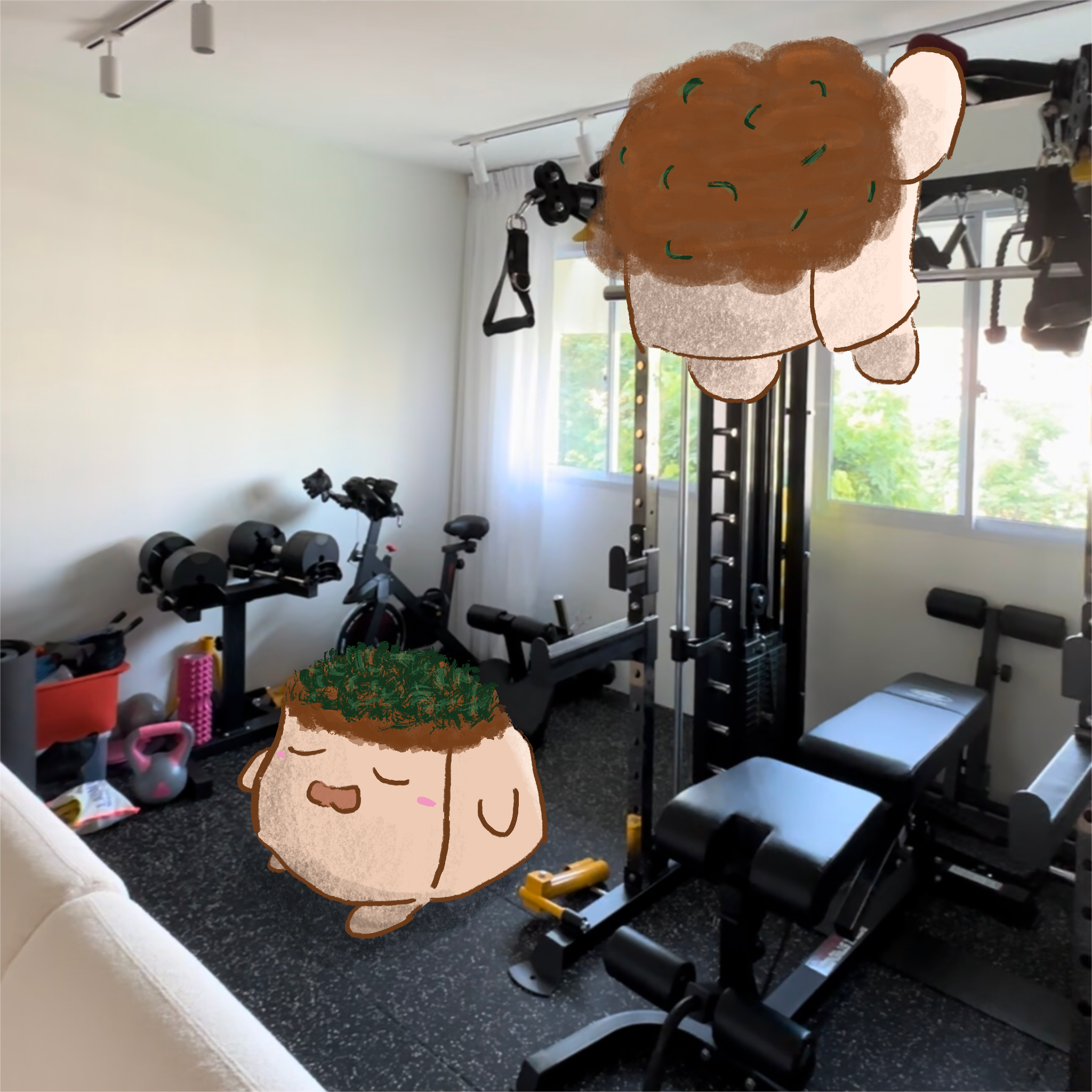

Setting up a home gym in a Singapore HDB flat is possible even if you only have one spare room, but space, flooring, noise and equipment selection need to be planned carefully. Our own home gym includes an all-in-one trainer, adjustable dumbbells, a treadmill, spin bike and rubber gym flooring, with the larger pieces chosen specifically because we had limited space.
We spent approximately S$8,186 on the major equipment and flooring listed in this guide, although you can build a functional Singapore home gym for considerably less if you start with adjustable dumbbells, a bench and floor mats.
After living with and regularly using our setup, this guide covers what we bought, what each item cost, what actually proved useful and what we would recommend to someone planning a home gym in an HDB.
Our Singapore home gym at a glance
- Home type: HDB flat
- Gym type: Dedicated home gym area
- Main focus: Strength training + cardio
- Main equipment: All-in-one trainer, adjustable dumbbells, treadmill and spin bike
- Flooring: Rubber gym mats
- Approximate setup cost: S$8,185+
- Best space-saving purchase: Adjustable dumbbells
- Biggest investment: BodyX MFORC All-in-One Trainer
- Would we build a home gym again? Yes, particularly because we work out frequently and value being able to exercise without travelling to a commercial gym.
Home Gym Non-negotiable
Gym floor mats (from Taobao)
Cost: S$350.08

It’s easy to get excited about all the equipment you’re going to fill your home gym, but a non-negotiable that you should plan for first is unfortunately none other than your gym floor mats.
Gym floor mats are not only meant to protect against slips and falls, but most importantly absorb the impact of your weights and reduce noise, while protecting your equipment and original tiles/vinyl from damage.
Even if you’re not planning to install a smith machine or all-in-1 trainer, we still highly recommend getting gym floor mats – at least for sections of the floor where you’re planning to do weighted workouts.
In case you accidentally drop your weights, you’re less likely to damage your original floor and get complaints from your downstairs neighbours. If you accidentally trip and fall, your injuries are likely to be less severe as well.
We checked local prices and found them way too expensive, considering that we wanted to cover the entire room’s floor space to protect our vinyl. We chose to buy our gym mats from Taobao and install them ourselves to save cost.
Get the gym floor mats here.
Our home gym equipment
1. Bodyx MFORC All-in-1 Trainer (from Homegym.sg)
Cost: S$5,690

While it is possible to get basic exercises (arguably also the best!) done with dumbbells, we wanted to expand our workout options. The answer to this in a space as tiny as ours was none other than an all-in-1 trainer.
We visited the Homegym.sg showroom to understand more about the different options before settling on the Bodyx MFORC All-in-1 Trainer. We initially considered the more popular Force USA, but the staff recommended BodyX instead as it is a reputable Korean brand with similar functions – but cheaper!
In addition, we also bought:
We’ve done a full review of the Bodyx MFORC All-in-1 Trainer if you’re keen to find out whether it’s worth the investment. In general, we find that it gives us quite a bang for our buck and covers most workouts that we would do in the gym. It costs less than the popular Force USA, so that helps too!
Get the Bodyx MFORC All-in-1 Trainer here.
2. Adjustable Dumbbells and Dumbbell Rack (from Taobao)
Cost: S$367.55

We use a range of weights depending on muscle groups, and the weights we lift are likely to increase over time (if we’re progressively overloading…!) Our solution to the lack of space was to buy adjustable dumbbells!
These are very useful in Singapore home gyms due to our tiny homes. If you’re not looking for a smith machine or all-in-one trainer, just the good old basics with dumbbells, this is definitely worth the investment.
We initially had some concerns about the plates being loose or clanking together, which is a common complaint about adjustable dumbbells. Local adjustable dumbbells are also very expensive, which made us rather hesitant about buying.
Luckily for us, we managed to find a Taobao store with glowing reviews & affordable prices, so we bit the bullet and ordered during the 11.11 sale!
These Taobao adjustable dumbbells we share here are working amazingly well for us despite our constant use, so we highly recommend getting these ones if you’re looking to build a well-furnished home gym despite the space constraints.
The dumbbell rack is another purchase worth considering if you don’t want to have to always bend or squat down to grab your dumbbells. We also bought our dumbbell rack from Taobao to save costs!
Get the adjustable dumbbells here and dumbbell rack here.
3. Spin bike (from Shopee)
Cost: S$229

This bike was not purchased specifically for the home gym – it was something Tofu V purchased during the lockdown period when she couldn’t go out to exercise but still wanted to be able to workout at home.
It has served her pretty well over the years and still works even after so many years, which is pretty incredible! The only downside is that she bought it when it was on sale, but since then the price has gone up so it’s not as cheap as it used to be anymore.
Get the spin bike here.
4. Treadmill
Cost: S$1.549

We bought this recently as a new addition to our home gym as we discovered that it was difficult to get in runs (and sometimes walks) with a newborn on our hands.
It’s foldable and can be quite compact! There is also no strong smell and takes the impact of running pretty well.
Get the treadmill here.
5. Yoga mats, exercise bands, kettlebells etc.

These were also purchased by Tofu V during the peak of her home workout days, mostly purchased on Shopee and all brought over to the tofu house!
Most of the items are pretty ordinary and you can get any random ones from Shopee, but the main one that we think is worth investing in is the Manduka eKO 5mm 71” Yoga Mat – EBB 2.0. This was a gift for Tofu V who enjoys her yoga workouts as much as her strength routines!
Technically we don’t do yoga in the home gym area itself as the space is limited – we do it in our living room where there’s more space. But if your home gym allows, do consider getting one of these mats that provide strong grip and prevents you from slipping during your workouts.
Get the Manduka eKO 5mm 71” Yoga Mat – EBB 2.0 here.
How Much Space Do You Need for a Home Gym in an HDB?
You don’t necessarily need an entire spare bedroom to create a useful home gym. How much space you need really depends on the type of exercise you do and, more importantly, the equipment you intend to buy.
If your workouts mainly involve yoga, resistance bands or adjustable dumbbells, you can get away with a relatively small workout area that can be packed away afterwards. Once you start looking at a treadmill, exercise bike, weight bench or an all-in-one trainer like ours, however, planning the room becomes much more important.
One thing we learnt from setting up our own HDB home gym is that you shouldn’t simply look at the dimensions of the equipment itself. You also need enough clearance to actually use it.
A bench needs space to be pulled in and out. Dumbbell exercises need enough room on either side for your arms to move comfortably. A treadmill needs accessible space around it rather than being squeezed tightly between other equipment. If you’re buying a rack or all-in-one trainer, you’ll also want to consider how far attachments, cables and benches extend when they’re in use.
Our home gym is fairly packed because we wanted to fit both strength and cardio equipment into the same space. We have our BodyX MFORC All-in-One Trainer, adjustable dumbbells, treadmill and spin bike in the room, so there isn’t a huge amount of empty floor space left over. In fact, when we want to do yoga, we usually bring our mats out to the living room instead.
That compromise works for us because we would rather dedicate the gym room to equipment that is difficult to move elsewhere.
Measure Your Equipment Before You Buy It
If you’re planning an HDB home gym, we would strongly recommend mapping everything out before ordering any large equipment.
Look at the full dimensions of each machine and mark the footprint on your floor with masking tape. Then walk around the imaginary equipment and try performing some of the movements you expect to do there.
It sounds slightly excessive, but a machine that looks reasonably compact on a product page can feel enormous once it arrives in an HDB bedroom.
Don’t forget to measure your doors, corridors and any tight corners between your front door and the eventual gym room too. Getting a large piece of gym equipment into the flat can be just as important as whether it fits once assembled.
For smaller HDB home gyms, multi-purpose equipment makes considerably more sense than trying to recreate a commercial gym at home. This is one reason we chose adjustable dumbbells rather than buying an entire rack of individual weights, and why we invested in an all-in-one trainer that allows us to perform multiple exercises using a single main piece of equipment.
The aim isn’t to squeeze as much gym equipment as possible into the room. It’s to leave yourself with a gym that you can actually move around and enjoy using.
What to Consider Before Building a Home Gym in an HDB
A home gym was something we deliberately planned for rather than a room we converted as an afterthought. If you’re renovating your HDB and already know that you want a dedicated workout space, it is worth thinking about the gym at the same time as the rest of your renovation.
Equipment is only one part of the equation. Flooring, noise, ventilation, electrical points and even how you get large equipment into the room can affect how practical the finished gym is.
1. Think About What You Actually Do at the Gym
Before shopping for equipment, make a list of the exercises you regularly do.
It is very easy to get carried away looking at racks, benches, cable machines and cardio equipment when planning a home gym. The better question is whether you will actually use all of it.
For us, strength training was important enough to justify dedicating a substantial amount of space and budget to the BodyX MFORC. We also knew that we would use cardio equipment, which is why we made room for both a treadmill and spin bike.
If you mainly use dumbbells and do bodyweight exercises, your ideal home gym could be much simpler. Adjustable dumbbells, a bench and a few smaller accessories can provide a surprisingly versatile setup without sacrificing an entire room.
2. Plan Your Flooring Before the Equipment Arrives
Flooring was one of the first things we considered because we wanted to protect the original vinyl underneath our gym.
We eventually bought rubber gym mats from Taobao and covered the workout area before installing our larger equipment. Apart from protecting the floor from weights and equipment, having a layer of rubber flooring also helps soften some of the impact and noise created while exercising.
This is especially important in an HDB where you have neighbours living directly underneath you. Even with mats, we wouldn’t treat a home gym like a commercial weightlifting gym and start dropping heavy dumbbells or weights onto the floor.
If you’re planning flooring as part of a renovation rather than simply laying removable gym mats over the existing floor, check the current HDB renovation requirements before proceeding. HDB has specific rules covering floor finishes and structural alterations.
3. Be Realistic About Noise
Noise is probably one of the biggest differences between working out at home and working out in a commercial gym.
A treadmill, jumping exercises and weights being placed on the floor can sound considerably louder to the neighbour downstairs than they do inside your own flat.
Rubber flooring helps, but your workout habits matter too. We try to place weights down rather than drop them, and it is worth being mindful of particularly high-impact workouts if you exercise very early in the morning or late at night.
A home gym should make your life more convenient without making your downstairs neighbour dread every workout.
4. Don’t Ignore the Weight of Your Equipment
Large gym machines and free weights can become surprisingly heavy once everything is concentrated in one part of a room.
This is one area where we would avoid relying on random figures from forums or assuming that because a commercial gym can hold a particular setup, an HDB bedroom can too. HDB’s current renovation guidance lists excessive floor-slab loading of more than 150kg per square metre among examples of disallowed building works.
That doesn’t mean you should simply treat 150kg/m² as a DIY equipment calculator, since the actual situation can involve the equipment footprint, existing finishes and how the load is distributed. If you’re planning an unusually heavy setup involving large machines, racks or substantial amounts of free weights, check the latest HDB requirements and get professional advice where necessary.
This is particularly worth thinking about before buying hundreds of kilograms of plates and placing everything in the same corner of the room.
5. Consider Ventilation and Air-Conditioning
Singapore is hot enough without voluntarily exercising in a small enclosed room.
If you’re planning your home gym during renovation, think about ventilation, fans and air-conditioning early rather than treating them as an afterthought. A room packed with large equipment can also feel much smaller once you’re exercising in it.
We would also think about where the air-conditioning unit, windows and fans are positioned in relation to taller equipment. You don’t want to design the perfect equipment layout only to discover that a tall machine obstructs a window or sits directly underneath something you need access to.
6. Plan Your Power Points
Not every piece of gym equipment needs electricity, but treadmills and certain other cardio machines do.
If you’re renovating, decide roughly where these machines will go before finalising your electrical points. It is much neater and more convenient than discovering later that the nearest socket is on the opposite side of the room.
We would also avoid planning the room on the assumption that extension cords can solve every problem. The final layout should make it easy to use and switch off your equipment without cables running unnecessarily across your workout area.
7. Think About Delivery and Installation
This is one of those things that’s easy to overlook until a very large machine is sitting outside your flat.
Before ordering bulky gym equipment, check its assembled dimensions, delivery requirements and whether installation is included. You may also need to consider your lift, front door, corridor and the entrance to the room itself.
Some larger machines arrive partially dismantled and are assembled inside the home, but you should confirm this with the seller rather than assume that anything advertised as a “home gym” will automatically fit through an HDB doorway.
This becomes particularly important if you’re buying equipment from overseas.
8. Leave Yourself Some Empty Space
Finally, resist the temptation to fill every available centimetre.
Our own gym is quite equipment-heavy, and we’re happy with that trade-off because we use the machines regularly. But having lived with the setup, we also appreciate how valuable empty floor space can be.
You need somewhere to stretch, pick up dumbbells, adjust your bench and simply move between exercises without constantly shifting things around.
If you’re working with a particularly small HDB room, we would rather have three pieces of equipment that get used every week than eight pieces squeezed together so tightly that working out becomes frustrating.
A good HDB home gym isn’t necessarily the one with the most equipment. It’s the one that makes it easier for you to exercise consistently at home.
Frequently Asked Questions About Home Gyms in Singapore
Can you build a home gym in an HDB flat?
Yes. A home gym can be incorporated into an HDB flat, although the practicality depends on your available space, equipment and workout style. Compact equipment such as adjustable dumbbells is much easier to accommodate than multiple commercial-style machines.
How much does a home gym cost in Singapore?
A basic home gym can be put together for a few hundred dollars, while a more comprehensive setup with strength and cardio machines can cost several thousand dollars. Our own setup cost approximately S$8,185 for the major equipment and flooring listed in this guide.
What is the best home gym equipment for a small HDB?
Adjustable dumbbells are one of our favourite options because one set replaces multiple pairs of fixed dumbbells. A foldable bench, resistance bands and compact cardio equipment can also make better use of limited space.
Do you need gym flooring for a home gym?
We strongly recommend protective flooring if you are using weights. Our rubber gym mats help protect our original flooring while also reducing impact and noise.
Can you put a treadmill in an HDB?
A treadmill can work in an HDB if you have sufficient space and choose an appropriate model. We use a foldable treadmill because it takes up less space than many full-size commercial machines.
Is an all-in-one trainer worth buying for a home gym?
It can be if strength training is a major part of your routine and you have sufficient room. We chose an all-in-one trainer because it lets us perform a much wider range of exercises without filling the room with several separate machines.
Is it cheaper to build a home gym or join a gym in Singapore?
A commercial gym has a much lower upfront cost, while a home gym requires a larger initial investment. Whether a home gym works out cheaper over time depends on how much you spend, how many people use it, how long you keep the equipment and what you would otherwise pay for gym memberships.
PIN THIS!


Leave a Reply